
Writings

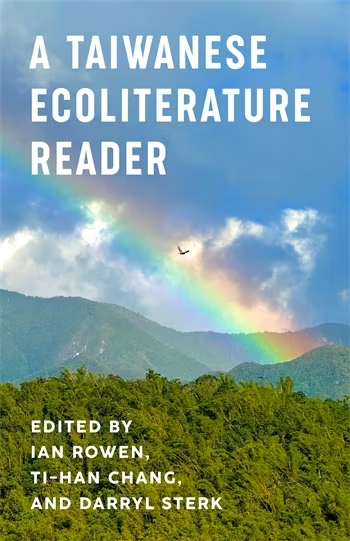
2025. A Taiwanese Ecoliterature Reader. Columbia University Press. (Co-edited with Ti-han Chang and Darryl Sterk)

An Indigenous hunter laments the decline in the flying squirrel population and reflects on how animals perceive the world. In a drought-stricken cyberpunk anytown, kids revolt against the grown-ups only to face off with stray dogs over water. During late-night diving sessions, a researcher encounters a mysterious group of ocean-dwelling people with gills. In an overpopulated future, marrying an AI spouse will raise a human’s credit score. A man follows the trail of an extinct leopard, seeking to unravel a metafictional mystery left behind by his late wife.

This anthology showcases cutting-edge works on ecological themes by essential and emerging Taiwanese authors, revealing the vitality of their engagements with environmental crises. Taiwan is a biodiversity hotspot and geopolitical flashpoint, home to both Indigenous peoples and settlers. The pieces collected in A Taiwanese Ecoliterature Reader give voice to this human and more-than-human diversity, telling tales that are disturbing yet hopeful, serious yet sensuous, speculative yet grounded, down to earth yet spanning the seas. They span Indigenous eco-writing, oceanic hybrid narratives, ecological sci-fi, and speculative Indigenous fiction. Together, these stories navigate the landscapes of Taiwanese ecoliterature, illuminating its past and pointing toward its future.

2023. One China Many Taiwans: The Geopolitics of Cross Strait Tourism. Cornell University Press.

One China, Many Taiwans shows how tourism performs and transforms territory. In 2008, as the People’s Republic of China pointed over a thousand missiles across the Taiwan Strait, it sent millions of tourists in the same direction with the encouragement of Taiwan’s politicians and businesspeople. Contrary to the PRC’s efforts to use tourism to incorporate Taiwan into an imaginary “One China,” tourism aggravated tensions between the two polities, polarized Taiwanese society, and pushed Taiwanese popular sentiment farther toward support for national self-determination.

Consequently, Taiwan was performed as a part of China for Chinese group tourists versus experienced as a place of everyday life. Taiwan’s national identity grew increasingly plural, such that not just one or two, but many Taiwans coexisted, even as it faced an existential military threat. This book’s treatment of tourism as a political technology provides a new theoretical lens for social scientists and area specialists to examine the impacts of tourism, not only in the region but worldwide.

2021. Transitions in Taiwan: Stories of the White Terror. Cambria Press.

Taiwan’s contemporary commitment to transitional justice and democracy hinges on a history of violence, for which this volume provides a literary treatment as essential as it is varied. This is among the first collections of stories to comprehensively address the social, political, and economic aspects of the White Terror and to do so with deep attention to its transnational character. Featuring contributions from some of Taiwan’s most celebrated authors and from genres that range between realism, satire, and allegory, this book examines the modes and mechanisms of the White Terror and party-state exploitation in prisons, farming villages, slums, military bases, and professional communities.

Transitions in Taiwan: Stories of the White Terror is an important book for Taiwan studies, Asian Studies, literature, and social justice collections.

This book is part of the Cambria Literature from Taiwan Series, in collaboration with the National Museum of Taiwan Literature, the National Human Rights Museum, and National Taiwan Normal University.